Knee Pain Location Chart: Identify the Source of Your Pain Quickly
Knee pain is one of the most common reasons people seek orthopedic care, but not all knee pain points to the same problem. A sharp ache along the outer edge of the joint is a very different experience from a deep throb directly behind the kneecap. That distinction matters more than most people realize. The location of your pain is one of the most valuable clues your body can offer, and it’s almost always the first question a specialist will ask.
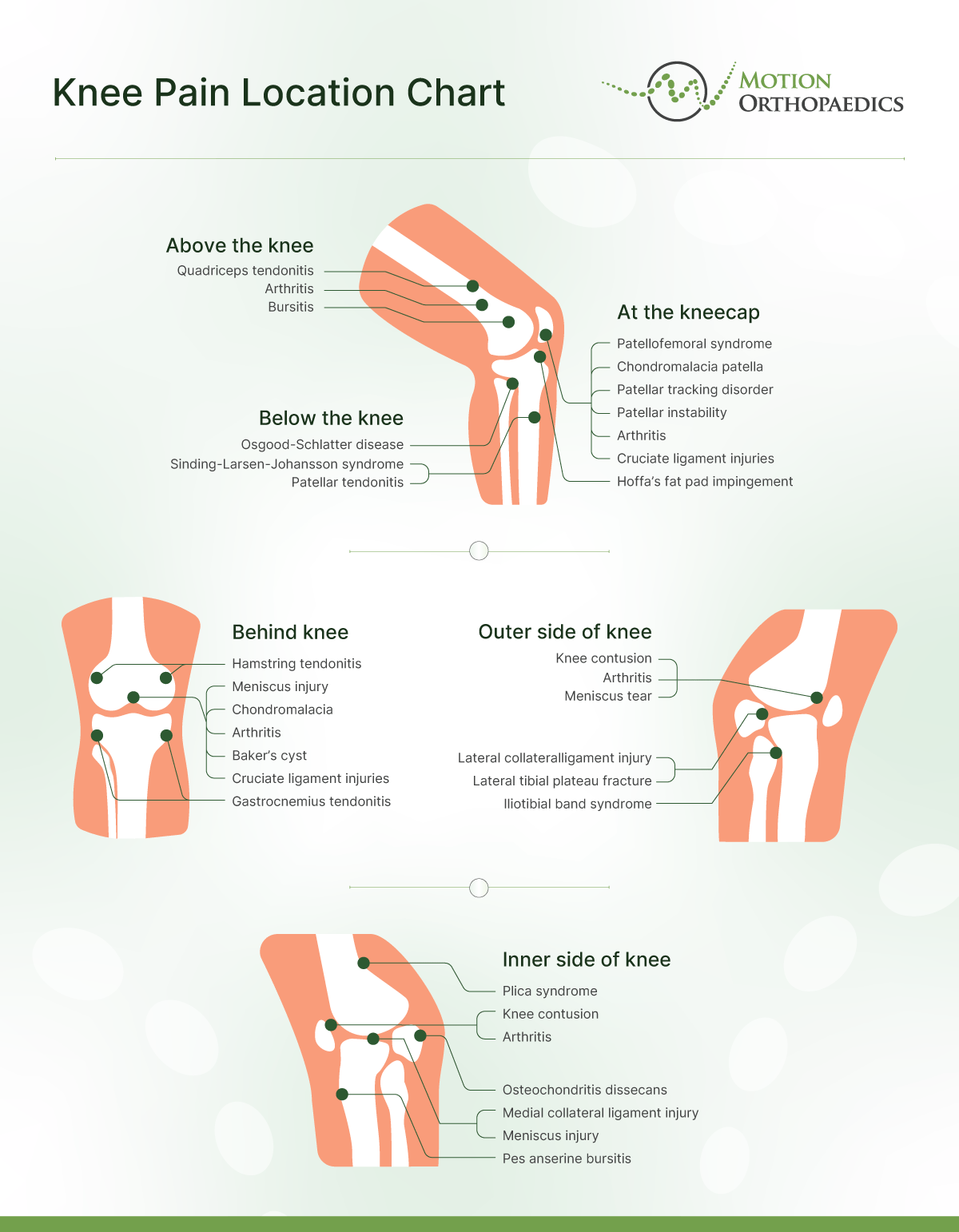
That’s the purpose behind a knee pain location chart. By organizing conditions by symptom location, this tool gives you a clearer starting point for understanding what might be happening in your knee. It helps you walk into your appointment ready to describe exactly what’s going on.
Why Knee Pain Location Is the Starting Point for Any Diagnosis
The Knee Has More Moving Parts Than Most People Expect
The knee brings together the femur (thigh bone), tibia (shin bone), and patella (kneecap), all held together by a network of ligaments, tendons, cartilage, and bursae, which are small fluid-filled sacs that cushion the joint during movement. Because so many structures occupy a relatively small space, a problem in one area can feel quite different from a problem just an inch or two away.
Understanding which structures are located in each region of the knee allows orthopedic specialists to interpret location as a diagnostic signal rather than just a description of discomfort.
How a Location Chart Makes Your Appointment More Productive
When a patient presents with vague knee pain without a clear sense of its origin, the evaluation naturally takes longer. When a patient can say, “the pain is right below my kneecap and gets worse going down stairs,” the specialist can move with much more precision. A knee pain location chart gives you the vocabulary to describe your symptoms accurately, and that accuracy translates directly into faster, more targeted care.
What Pain in the Front of the Knee Usually Means
Above and Below the Kneecap
Pain above the kneecap typically involves the quadriceps tendon or the bursae in that area. Quadriceps tendonitis and bursitis are the most common culprits, and both tend to flare with activities that load the front of the thigh, like squatting, stair climbing, or prolonged kneeling.
Just below the kneecap, pain usually centers on the patellar tendon and its attachment points. Patellar tendonitis, sometimes called jumper’s knee, is an overuse injury common in basketball players, volleyball players, and runners. In adolescents who are still growing, Osgood-Schlatter disease can cause pain in this same zone by stressing the growth plate during periods of rapid development.

At the Kneecap Itself
The kneecap region is where some of the most common knee conditions occur. Patellofemoral syndrome, often called runner’s knee, develops when the patella doesn’t track smoothly through its groove, creating irritation in the cartilage underneath. Chondromalacia patella refers to the softening and breakdown of the cartilage, producing a similar aching sensation that often worsens after prolonged sitting.
Other conditions at the kneecap include patellar instability, patellar tracking disorders, and Hoffa’s fat pad impingement, a less commonly recognized condition in which the fat pad just below the kneecap becomes pinched between the bones.
Pain on the Inner, Outer, and Back of the Knee
Inner and Outer Knee Pain
The inner knee is a common site for injuries to both the ligaments and the meniscus. Medial collateral ligament sprains typically result from a force applied to the outside of the knee, while medial meniscus tears are frequent in athletes who pivot or rotate under load. The inner knee can also be affected by plica syndrome, pes anserine bursitis, and arthritis.
The outer knee is most closely associated with iliotibial band syndrome, an overuse injury in which the thick band of connective tissue running along the outside of the thigh repeatedly rubs against the femur. Runners and cyclists are particularly prone to this condition. Lateral meniscus tears, lateral collateral ligament injuries, and lateral tibial plateau fractures round out the most common causes of outer knee pain.
Pain Behind the Knee
Posterior knee pain has its own distinct set of causes. A Baker’s cyst, a buildup of excess joint fluid that forms a visible bulge behind the knee, is one of the more recognizable. It often develops in response to another condition inside the joint, such as arthritis or a meniscus tear, that triggers excess fluid production. Hamstring tendonitis and gastrocnemius tendonitis are also common causes of pain in this area, particularly among runners who increase their training volume too quickly.
What to Do When Knee Pain Isn’t Going Away
What the Evaluation Process Looks Like
At Motion Orthopaedics, diagnosing knee pain begins with a thorough, structured evaluation. Your orthopedic specialist will work through the following steps:
- A detailed conversation about when the pain started, which activities aggravate it, and how it has changed over time.
- A physical examination to assess the range of motion, tenderness, swelling, and joint stability.
- Functional movement testing to observe how your knee performs across different activities.
- Imaging studies, including X-rays or MRI scans, when the physical findings suggest a structural issue that needs visual confirmation.
When to See a Specialist
Occasional soreness after a tough workout often resolves with a few days of rest. But certain symptoms signal something more significant. You should schedule an evaluation if your knee pain has lasted more than a couple of weeks without improving, if swelling is present or worsening, or if your knee feels unstable or as if it might give way during everyday activities.
Early diagnosis consistently leads to more treatment options and shorter recovery timelines. Many conditions respond well to conservative care, including physical therapy, bracing, or targeted injections, when they’re caught before they progress. Waiting allows inflammation to become chronic and cartilage to wear further, which complicates recovery and can narrow your options.
The specialists at Motion Orthopaedics are experienced in diagnosing and treating every condition shown in the knee pain location chart above. Whether your pain is on the inner side, the outer edge, at the kneecap, or behind the joint, we’ll identify the source and develop a personalized plan to help you return to full function. Contact us today to schedule your appointment.